In early 2026, as she was completing her first year as a molecular biology major at Rockhurst University in Kansas City, Missouri, Lavanya Sharma hoped to return home to Kalamazoo to spend her summer delving into hands-on research.
That goal led Sharma, an alumna of Portage Central High School and an aspiring physician, to reach out to Michael Gutknecht, PhD, a research scientist who works in the Rothstein Lab in the Center for Immunobiology at WMU Homer Stryker M.D. School of Medicine (WMed). And what followed was a life-changing experience for Sharma who got the opportunity to work closely with Dr. Gutknecht and Thomas L. Rothstein, MD, PhD, chair of the medical school’s Department of Investigative Medicine who leads the Center for Immunobiology, on groundbreaking experiments to learn more about the function of extracellular vesicles (EVs) produced by B cells.
“I had never done this type of research before and I knew I wanted to be at WMed because it is a main research hub in Kalamazoo,” Sharma said. “B cells and immunology are two things I’m really interested in and with the Rothstein Lab there were so many ongoing projects and so much science happening that it seemed like a great place where I would be able to learn about a lot of different things that are happening.”
For Sharma, her time in the Rothstein Lab was made possible through the Science Research Enrichment Program, an eight-week pathway program at WMed that pairs rising second-year, third-year, and senior-year college students with a WMed scientist. The summer program provides direct, hands-on laboratory work experience for students who have not had an opportunity for a deep dive into top-level research in their previous coursework or job experiences.
Sharma was one of 10 students who made up the cohort of learners who took part in this year’s Summer Research Enrichment Program from June 1 to July 21, 2026. During her time at WMed, Sharma helped expand upon research by Dr. Gutknecht that has shown that B cells produce EVs of two different sizes that contain antibodies and that B cell EVs can enter target cells, something that soluble antibodies cannot readily do.
That knowledge has led Dr. Gutknecht and Rothstein to speculate that B cell EVs that contain antibody constitute a novel system of antibody distribution within the body, which may be important in counteracting infectious and other diseases but may be pathogenic in autoimmune dyscrasias in which autoreactive antibodies are produced. As their research continues, it is focused on learning more about the mechanisms by which B cell EVs are produced, the composition of B cell EVs, and the activities of antibody contained within B cell EVs.
As part of her research this past summer, Sharma worked in the lab to isolate B cell EVs and added them to the HeLa cell line to learn more about how the EVs were intracellularly trafficked after entering the cell, whether the EVs associated with the nucleus of the host cell, and if there was any physical evidence of EV-nuclear association using isolated nuclei.
“She utilized biochemistry, confocal microscopy, and flow cytometry techniques and really jumped in trying to understand how vesicles and nuclei may interact,” Dr. Gutknecht said. “She was able to develop a protocol to isolate nuclei and observed vesicles attached to the nucleus, producing visual confirmation of the interaction. We had talked about that going in but Lavanya went above and beyond in looking at what might be controlling this process.”
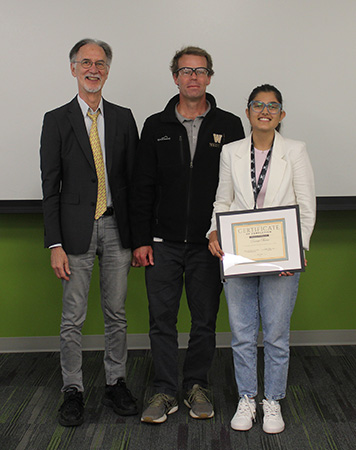
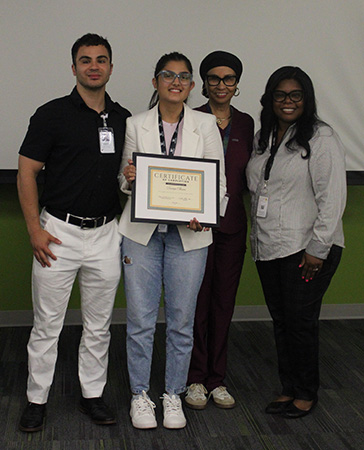
Sharma got the chance to summarize her findings at the conclusion of the Science Research Enrichment Program in July in her presentation, “Intracellular Trafficking and Nuclear Association of 2kG Extracellular Vesicles.”
Sharma also got the opportunity to continue working with Drs. Gutknecht and Rothstein after the summer pathway program had concluded and stayed on at WMed until August. She said she was grateful for the overall experience, which gave her the opportunity to not only work in the lab but also to take part in weekly meetings with researchers at WMed, gather feedback on the work she was doing, and strengthen her literary research skills. She said she has talked with Dr. Rothstein about the possibility of returning to his lab next summer.
“That collaboration and that feedback is really nice,” she said.
Sharma said she also appreciates that her work and the findings it produced will allow Dr. Gutknecht to continue to make progress in his research of B cell vesicles and how they function. She said she was also grateful to Cheryl Dickson, MD, MPH, associate dean for Community Education and Engagement at WMed; Candace Moore, Manager of Pathway Programs, and Joey Cervone, on-call coordinator of Pathway Programs, for their leadership of the Science Research Enrichment Program.
Now in her second year of college, Sharma said the research experience she gained at WMed equipped her with important skills that she is now using in research projects at Rockhurst University. At Rockhurst, Sharma is enrolled in the school’s BS-DO track, a seven-year program in which she will earn her Bachelor of Science degree from Rockhurst University and a DO degree from Kansas City University College of Osteopathic Medicine.
“I think the way the program at WMed is structured works really well,” Sharma said. “It allows you to gain skills that are really beneficial in the lab and outside the lab, and you learn how to work in a professional environment with people who are really masters of their craft. You get to understand the foundations of research and it’s an experience I will remember for a really long time.”