
When Tyler Gibb, JD, PhD, attended a family reunion in Utah in the summer of 2022, his relatives caught sight of his wife’s new tattoo, a recent addition on one of her arms that she got along with her sisters.
As conversation ensued, Dr. Gibb recalls, his 91-year-old grandmother leaned over to tell him, “I’m a tattooed lady also.”
The revelation took Dr. Gibb by surprise as his beloved Grandma Nancy was a lifetime member of the Church of Jesus Christ and Latter-day Saints where there has historically been a strong doctrinal prohibition to tattooing.
“My interest was immediately piqued and my follow up was, ‘When did you get the tattoo?’,” Dr. Gibb said.
The question and what he learned in that moment – that his grandmother had a small tattoo just under her left armpit identifying her blood type – spawned for Dr. Gibb, co-chair and associate professor in the Department of Medical Ethics, Humanities, and Law at WMU Homer Stryker M.D. School of Medicine (WMed), what has become a nearly four-year journey to learn more about “Operation Tat-Type,” a Cold War-era endeavor to permanently mark every American with their blood type and Rh status.
Even more, he and his team have wondered, how might such a program inform public health policy today?
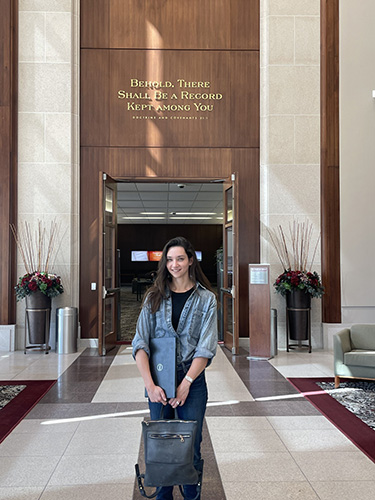
To find answers, Dr. Gibb, along with Kristin Alyousif, MLIS, assistant professor in the Department of the Medical Library, and M4 Grainne Caughey, has embarked on a journey of extensive research, interviews with Grandma Nancy, a visit by the team to her hometown of Richmond, Utah, to gather the stories of other blood-type tattoo recipients, and hours’ worth of review of documents from the LDS Church History Library.
In 2025, the project was awarded a $5,000 Luce-AAR Advancing Public Scholarship Grant from the American Academy of Religion to fund the production of the series “Inked by Faith” that will be co-hosted by Dr. Gibb and Devan Stahl, PhD, associate professor of bioethics in the Department of Religion at Baylor University, on the duo’s podcast “Bioethics for the People.”
An introductory episode of the series is already available on the Bioethics for the People website and Dr. Gibb said the first of four episodes of “Inked by Faith” will be released in July 2026.
“This project is a vehicle for our students like Grainne to be a part of quality medical humanities research and that’s really valuable,” Dr. Gibb said. “From an academic and historical documentation perspective, we’re collecting these records that have never been compiled before, so it’s a novel research project documenting a really interesting moment in social, political, medical, and scientific history.”
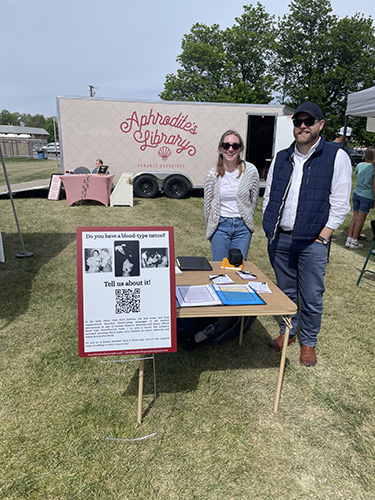
The research and documentation by Dr. Gibb and his team, according to an ongoing narrative of their research, showed that “Operation Tat Type” took root in the U.S. – specifically in northern Utah, Lake County, Indiana, and Montgomery County, Ohio – as early as 1950 as the Cold War and the associated arms race sparked fears of an atomic attack and a growing public interest in civil defense.
“Concerns for mass casualty events and an understanding of the importance of blood type matching made it apparent that access to typed blood would be essential for successful medical intervention,” the team wrote in the narrative.
The initial proposal and development of “Operation Tat-Type” is attributed to Dr. Andrew C. Ivy, a Chicago physician who attended the University of Chicago and served as chair of the Division of Physiology and Pharmacology at Northwestern University Feinberg School of Medicine for 20 years. Dr. Ivy is most well-known for his role as an expert witness at the Nuremberg Doctors’ Trial in 1947 and he and Dr. Leo Alexander are credited with authoring the Nuremberg Code which provided the ethical framework for human subject research.
By August of 1950, Dr. Ivy’s plan to tattoo every Chicagoan with their blood type and Rh factor became public knowledge and “the necessity of the venture was emphasized, describing how civilians might serve as blood donors to those injured in the event of an attack,” according to the team’s research.
The calls for the mass blood-type tattooing in Chicago, though, proved to be unsuccessful. However, 15,000 people in nearby Lake County, Indiana, were blood-typed voluntarily and two-thirds of them were tattooed. In Michigan, the effort took on another form as 40,000 of 50,000 residents in Jackson County were blood-typed in 1950 and received metal dog tags inscribed with their blood type. That same year, 60,000 residents in Saginaw were also blood-typed and tagged and, by 1952, 1.5 million Michigan residents had participated in the blood-type identification programs.
The team found that despite the national rhetoric surrounding “Operation Tat-Type,” the project “functioned primarily as a constellation of local initiatives” from 1950 to 1956.
In Cache and Rich counties in northern Utah, which is part of a region of the U.S. that is predominantly Mormon, adoption and acceptance of blood-type tattooing was nearly universal after it began there in May 1951 and blood-typing and tattooing drives were organized at hospitals, clinics, and elementary schools
According to Dr. Gibb and his team, the rapid implementation of the practice in the two counties is credited to Drs. Oliver W. and Omar S. Budge, two well-known and respected physicians. As it turned out, Oliver W. Budge attended medical school at Northwestern University at same time that Dr. Ivy was a member of the faculty.
Dr. Gibb’s grandmother told him and his team that she was in her 20s when she visited a local school in Richmond, Utah, to receive her blood-type tattoo. The tattoo was applied using a Vibro-Tool, a device normally reserved for engraving on wood and metal surfaces.
Dr. Gibb said his grandmother recalled initially having reservations about getting a blood-type tattoo given the Mormon church’s overall ban on tattoos. However, she moved forward with the tattoo after church leaders assured her it was OK.
"This was a very rural farming community, and whatever church leaders said to do, community members did," Alyousif said. "It was a way to take care of each other. There was also a fear of communism and Stalin, and folks really feared a nuclear weapon could hit them."
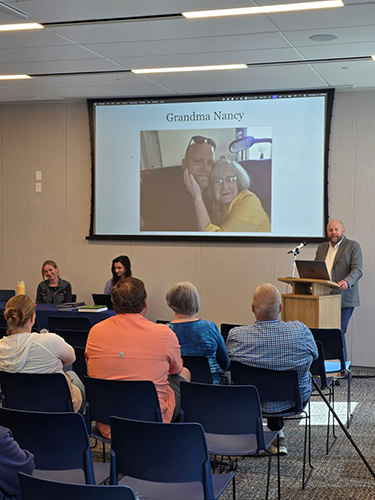
In mid-May, as part of their ongoing research, Alyousif, Caughey, and Dr. Gibb traveled to Cache Valley where they were invited to speak and present “Inked by Faith: Blood-Type Tattoos, Cold War Preparedness, and Community Memory in Cache Valley in the early 1950s,” as part of an America 250 Lecture Series at the Logan Library in Logan, Utah.
Their lecture on Saturday, May 16, drew a crowd of about 30 to 40 people, including Dr. Gibb’s grandmother and other family members. The event gave the team the chance to present their research to the community and gather more firsthand accounts from people who received blood-type tattoos.
“A third of the people there had a tattoo or were married to someone who had the tattoo,” Dr. Gibb said.
Dr. Gibb said Grandma Nancy, who turned 95 in May 2026, has been “blown away” by the extensive research he and his team have done and the community response it has generated since that day in 2022 when she told Dr. Gibb about her tattoo.
Said Alyousif: "The biggest thing that stood out was that everyone in the community believed, at the time, that everyone else in the country had a tattoo. It was unremarkable, just like receiving the polio vaccine."
"What was really interesting to me is how religious communities had the common goal to come together and do something so invasive," Alyousif added. "It's a tattoo … but the community and its religious leaders said we have to do this for each other. They did what they felt was practical for themselves, their families, and their entire community."
As they look ahead, Dr. Gibb said the extensive work and research by the team has revealed findings that bear further investigation, among them a broader question “about political power vis-à-vis people’s bodies and medical decisions in the name of national pride or military objectives and how people, from a critical perspective, become integrated into those questions about power and authority.”
“Several academic manuscripts will come out of this, in addition to the podcast miniseries, and full-length book,” he said.