
As he spoke about the last four years he and his classmates spent at WMU Homer Stryker M.D. School of Medicine (WMed) pursuing their dreams of becoming physicians, M4 Chidambaram Nachiappan couldn’t help but recall all that they had learned during their time in Kalamazoo.
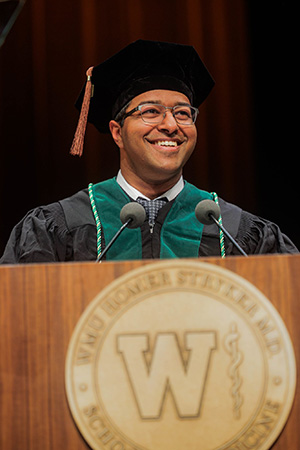
But even more important than the vast knowledge they gained, Nachiappan said, was that the journey was one they went through and experienced together as members of the MD Class of 2026.
“The truth is, any of us could have gone to a different medical school and would still become a great physician,” Nachiappan said to his classmates and their families and friends who gathered on Thursday, May 7, 2026, for commencement at WMU’s Miller Auditorium. “We would have studied hard, taken the exams, and learned how to care for our patients. But it wouldn’t have been like this. It wouldn’t have been with this group of people, this community, and this experience.
“It’s the people here who made this journey what it was,” he added. “It’s the group chats where you can complain and joke about the stresses of the day. It’s staying an extra hour to review for an exam because someone suggested it, and suddenly, you’re all in it together … Those are the things that made medical school more than just something we got through. They’re what made it something we’ll actually miss.”
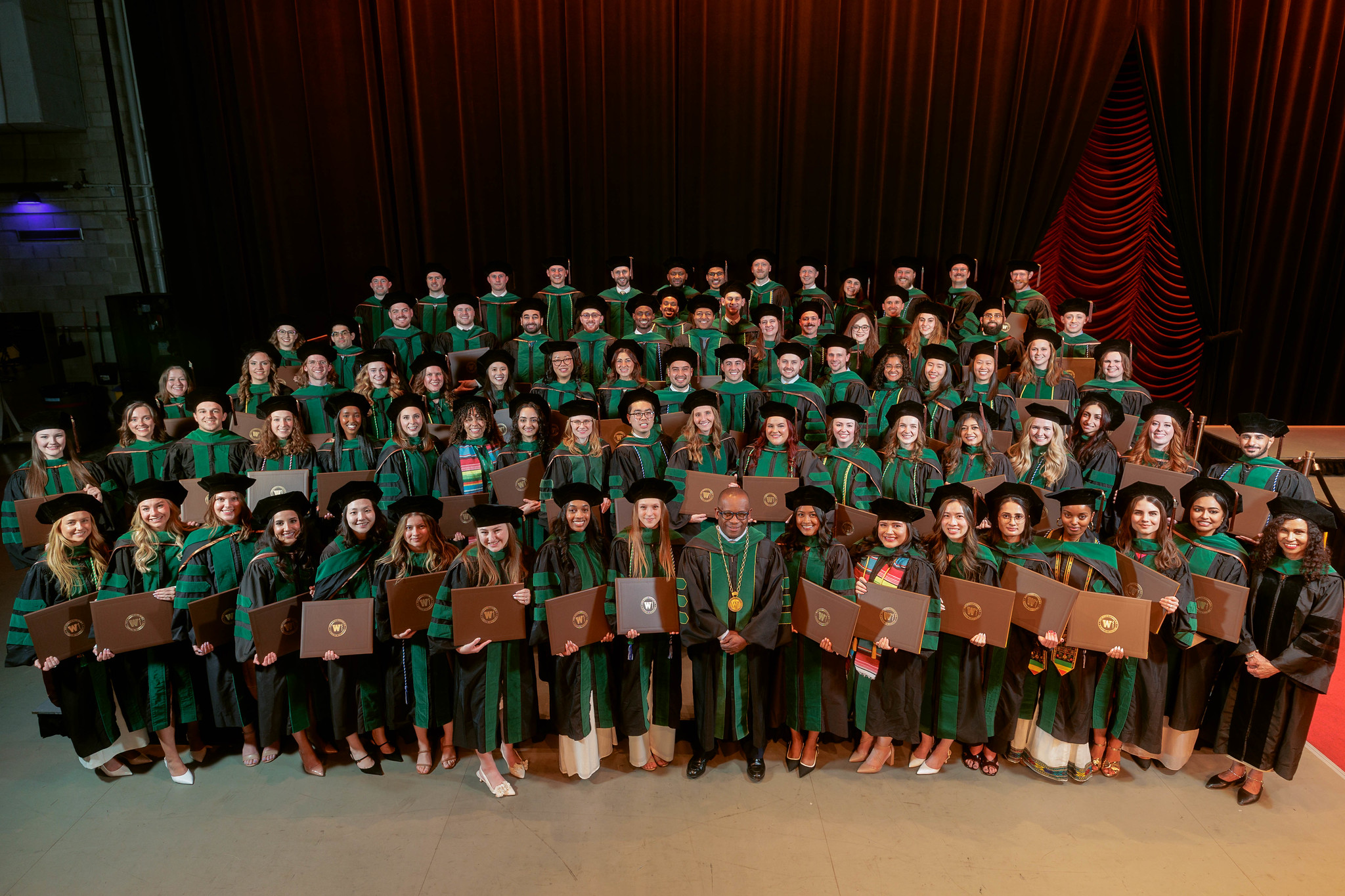
The commencement ceremony was a celebration for the medical school’s ninth class of new doctors, as well as graduates of the Master of Science in Biomedical Sciences degree program. The event rounded out what was a busy final week for the students as they were honored at a class awards ceremony on Monday, May 4, and at a celebration brunch at WMU’s Heritage Hall on Wednesday, May 6.
J. Adrian Tyndall, MD, MPH, FACEP, the Hal B. Jenson, MD Dean, President and CEO of WMed, told the students in the Class of 2026 he was honored to speak at what was his first commencement as dean since taking the helm of the medical school in March. He applauded the graduates, as well as their families, friends, mentors, faculty, advisors, and loved ones, for enduring the shared sacrifices that brought the students to the momentous milestone.
“You are becoming physicians, scientists, and clinician-leaders in a profession undergoing profound change and you are doing so with the understanding that excellence in medicine cannot exist without equity,” Dr. Tyndall said. “Health equity for all is not a slogan for WMed; it is inherent in our mission and our way of seeing the world.
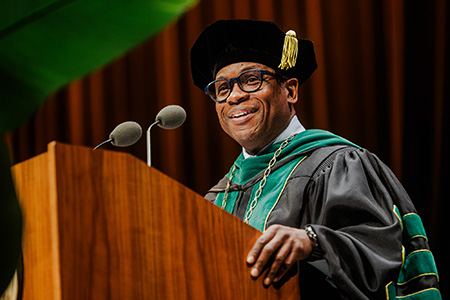
“We must recognize that health outcomes are shaped long before a diagnosis is made,” Dr. Tyndall added. “They are shaped by environments, opportunity, access, and history. From your time at WMed, you know to look beyond individual encounters and ask deeper questions about systems, structures, and accountability. You have been educated here not only to master knowledge, but to notice patterns. Not only to solve problems, but to ask who those solutions reach. And who they miss. That perspective will matter, no matter where your career takes you next.”
In his keynote remarks to the Class of 2026, Burton W. Lee, MD, told the students that becoming a physician is privilege like no other and a noble profession filled with meaningful and impactful work.
“Being a physician is a privilege,” said Dr. Lee, who serves as president and CEO of the Medical Benevolence Foundation, a nonprofit global health organization that cares for vulnerable patients in resource limited countries. Prior to that role, Dr. Lee was head of Medical Education and Global Clinical Care in the Medicine Department at the National Institutes of Health.
“It is a privilege that we get to make life-saving impact in another person’s life,” Dr. Lee added. “It is also a privilege that patients trust you with their most intimate personal details, perhaps something that they have not shared with any other human being.”
While being a doctor is incredibly rewarding, Dr. Lee told the students that the work they will do can also be very taxing and lead to burnout. With that in mind, he offered up importance advice based on three research studies and an important number from each of those studies.
The first figure Dr. Lee offered up was 105,000, which is the annual income in North America at which life satisfaction plateaus, according to a 2018 study published in the journal Nature. Given the finding, Dr. Lee encouraged the students to not always pursue the highest salary as they progress through their careers. Instead, he told them to focus on work that also allows time for protected academic time or time to volunteer at a local free clinic.
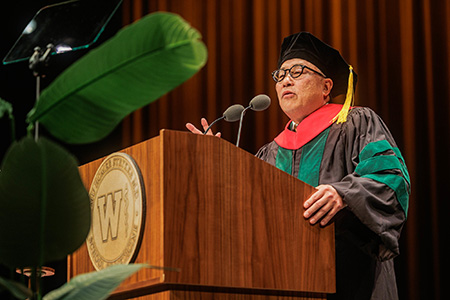
The second number from Dr. Lee was 20, which is the percentage of professional time spent by physicians doing work they find “deeply meaningful” who were found to be significantly protected against burnout, according to a 2009 study from the Mayo Clinic.
“Often the advice given to mitigate the risk of burnout is to take time off, go to the Caribbean, or practice mindfulness,” Dr. Lee said. “You should certainly take care of yourself and definitely consider those things. However, the irony of the 20 percent rule is that these activities – whether it is teaching a student or volunteering at a free clinic – actually take more time and are typically uncompensated. Yet engaging in meaningful activities can be life-giving and it can restore your soul, and despite the ‘extra work,’ you are likely to find yourself more energized and engaged.”
The last number Dr. Lee talked about was the simplest – the number one. That is, he said, the “one indisputable truth encapsulated in the ancient practice of memento mori, a Latin phrase which means ‘Remember that you will die.’”
Dr. Lee said a 2010 systematic review suggested that being reminded of memento mori causes people to seek deeper relationships, to be more grateful for life, make better use of their time, and make better health decisions.
“Whether we like it or not, as physicians, we have many natural opportunities to see death up close,” Dr. Lee said. “This gives us the unique privilege of practicing memento mori. Memento mori is actually not about focusing on death. Instead, it is a tool for living well – thriving in life.
“When you remember your own mortality, it forces you to align your daily actions with your core values. It brings out what is at your core - your humanistic, existential, and spiritual identity,” he added. “It clarifies what really matters – not the money you make, not the prestige of your job title, but the integrity with which you treated the person in front of you and the love you gave to those waiting for you at home.”